


Zoho Inventory for E-Commerce: Automating Orders, Stock and Fulfillment
November 23, 2026

If your e-commerce business is juggling orders across multiple sales channels, updating stock manually, and struggling to keep fulfillment on schedule, your inventory processes may be slowing down your growth. A product marked as available on your website might already be sold out, while orders wait to be processed because your systems are not communicating with each other. Zoho Inventory for e-commerce helps businesses bring order management, stock tracking, and fulfillment into a more connected workflow.
As online stores expand across marketplaces, websites, and physical locations, managing inventory accurately becomes increasingly important. With the right configuration and integrations, businesses can reduce repetitive administrative work, improve stock visibility, and create a smoother experience from the moment a customer places an order to the moment it arrives at their door.
Why E-Commerce Businesses Need Smarter Inventory Management
Growing online stores often face challenges that go beyond simply counting products. Stock levels change with every sale, returns need to be recorded, and teams must coordinate purchasing, packing, shipping, and customer communication. Without a centralized system, these processes can become difficult to manage. Employees may need to update spreadsheets, check multiple platforms, and manually reconcile orders to determine what is actually available. Effective e-commerce inventory management addresses these challenges by providing a more reliable view of stock and order activity. Zoho Inventory helps businesses track items, manage sales and purchase orders, monitor warehouse stock, and coordinate shipments through a centralized platform. For example, when an online store receives several orders for the same product, an organized inventory workflow helps the team monitor available quantities and identify when replenishment is needed. This reduces the risk of overselling and helps purchasing decisions reflect actual demand.
Automating Orders with Zoho Inventory Integration
For businesses selling through multiple channels, manually transferring order details between platforms creates unnecessary work and increases the risk of errors. Zoho Inventory integration helps connect inventory operations with supported e-commerce stores, marketplaces, accounting applications, and shipping services. Depending on the platforms and configuration, businesses can streamline several essential processes:
- Order Synchronization: Bring sales orders from supported sales channels into a centralized workflow, reducing the need to enter the same information repeatedly.
- Stock Level Updates: Keep inventory quantities synchronized across connected channels where supported, helping prevent sales of unavailable products.
- Invoice and Payment Coordination: Connect relevant sales and accounting processes to improve transaction visibility and simplify financial reconciliation.
- Shipping and Tracking: Integrate supported shipping services to help teams process shipments, generate shipping labels, and monitor delivery status.
- Returns Management: Record returned products and update stock according to their condition and the applicable return workflow. These integrations help create a more consistent flow of information between sales, inventory, and fulfillment. However, the exact level of automation depends on the connected platforms, subscription plans, and integration settings. Businesses should validate synchronization rules and exception handling before relying on automated workflows at scale.
Streamlining Stock Management and Order Fulfillment
Automation is most valuable when it addresses the everyday bottlenecks that delay orders. With a properly configured Zoho Inventory implementation, e-commerce businesses can establish clearer processes for managing stock, replenishment, and shipping. Consider a store selling hundreds of products across multiple categories. Without reliable stock tracking, the team may only discover a shortage after an order has been placed. With organized inventory records and reorder points, the business can identify low-stock items earlier and plan purchasing more effectively. A streamlined fulfillment workflow can include: Order Capture: Sales orders enter the inventory system through supported integrations or configured processes. Stock Verification: Available quantities are checked, helping the team identify shortages before fulfillment. Picking and Packing: Warehouse staff prepare the correct products and quantities for each order. Shipment Processing: Shipping details and tracking information are recorded through the relevant fulfillment integration. Inventory Reconciliation: Returns, adjustments, and new stock receipts are recorded to maintain accurate inventory records. For businesses managing multiple warehouses, Zoho Inventory also offers warehouse-related capabilities that can help teams monitor stock across locations. Proper setup is important to ensure that the system reflects actual warehouse procedures and that employees understand how to record transfers, adjustments, and fulfilled orders.
How Zoho Inventory Supports E-Commerce Growth
As order volumes increase, processes that once worked for a small store can become difficult to maintain. More orders mean more stock movements, more shipment coordination, and greater pressure to keep product information accurate.
A scalable inventory system helps businesses respond to these demands without relying entirely on additional manual work.
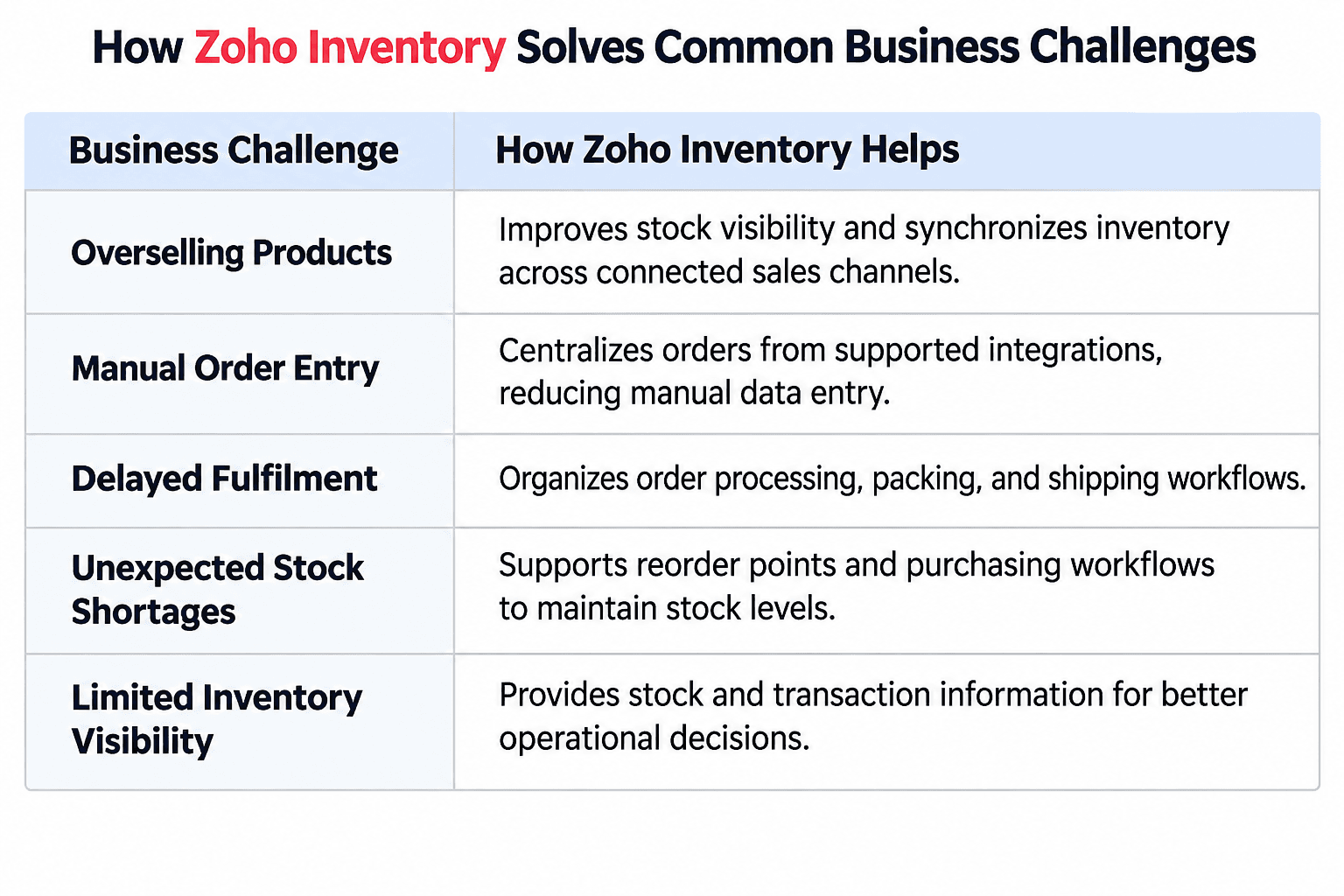 The result is greater visibility across inventory operations and a stronger foundation for growth. Businesses can also use inventory and sales reports to identify product demand patterns, monitor stock movement, and make more informed purchasing decisions.
Why Partner with Mango Technologies?
Choosing an inventory platform is only the first step. To achieve meaningful improvements, businesses need a system that reflects their sales channels, warehouse procedures, and fulfillment requirements. A poorly planned Zoho Inventory implementation can leave teams dealing with disconnected applications, inconsistent stock figures, and workflows that still require manual intervention.
At Mango Technologies, we help businesses configure Zoho solutions around their operational needs, focusing on practical automation and reliable information flow. Our implementation approach includes:
- Process Assessment: We review your current order management, inventory tracking, purchasing, and fulfillment workflows to identify inefficiencies.
- System Configuration: We configure inventory records, warehouses, stock rules, and order processes to align with your business requirements.
- E-Commerce Integration: We help connect supported sales channels and relevant business applications to reduce repetitive tasks and improve synchronization.
- Testing and Optimization: We validate key workflows, identify potential integration gaps, and refine the system as your order volumes and operational needs evolve. With the right Zoho Inventory integration strategy, e-commerce businesses can reduce manual work, improve stock accuracy, and coordinate fulfillment more efficiently. Your inventory system should do more than record what you have in stock. It should help your business process orders confidently, anticipate replenishment needs, and deliver a better customer experience as sales grow.
Contact Mango Technologies today! to explore how Zoho Inventory can help automate your e-commerce operations, from order management to fulfillment.